beta
beta
South Tyrol, Italy
June – September
7 nights
6 stays
Ladin culture
Sleeping at 2,054 metres is not a stunt here — it is the point. On Europe's largest high meadow the road closes to cars by day, and after the last cable car those fifty-six square kilometres hold a few dozen people. Either side of that hinge lie two Ladin valleys, one pass apart: Val Gardena, whose farmers have been carving stone pine into altarpieces for four hundred years, and Alta Badia, whose mountain huts employ sommeliers. Of the four journeys this is the walker's — three of its days end at a hut. Pack for the meadow nights and arrive with your first word of Ladin.
There is a corner of the Dolomites where Italian is the third language. Ladin came first — a Rhaeto-Romance tongue spoken among these peaks since Roman soldiers mixed their Latin with whatever the mountain people spoke before — and around thirty thousand people still live in it: dreaming, arguing, printing their newspapers in it. This journey stays inside that language for a week, because its two heartland valleys, one pass apart, developed the same inheritance in opposite directions.
In Val Gardena, that inheritance turned into carving: four hundred years ago its farmers began filling the dark months with knives and stone pine, and by the nineteenth century a valley of a few thousand souls had altarpieces standing in churches from Warsaw to Buenos Aires — a craft that never stopped. In Alta Badia, it turned into cooking: for eight hundred years the valley answered to an abbess — Badia means, simply, the abbey — and in living memory it became one of the great tables of the Alps.
Between the two lies the hinge: the Alpe di Siusi, Europe's largest high meadow, where the road closes to cars and a dairy hamlet lets you sleep at 2,054 metres. The itinerary reads in that order — the knife, the meadow, the table.
Stays
6
01
La Perla
02
Aman Rosa Alpina
03
Zallinger
04
Schgaguler Hotel
05
Berghotel Ladinia
06
Icaro
Restaurants
10
01
La Stüa de Michil
02
L'Murin
03
L'ostì
04
Maso Runch
05
Baita Sofie
06
Gostner Schwaige
07
Tierser Alpl
08
Rauchhütte
09
Rifugio Scotoni
10
Regensburger Hütte
Sites
20
01
Castelrotto
02
Hauenstein · Wolkenstein
03
Seceda
04
Col Raiser
05
Resciesa
06
Museum Gherdëina
07
UNIKA Ateliers
08
Alpe di Siusi
09
Puflatsch
10
Rosszähne
11
Sassolungo · Circuit
12
Forcella del Sassolungo
13
Passo Gardena
14
Museum Ladin Ćiastel de Tor
15
La Val · Viles
16
La Crusc
17
Armentara
18
Ju de Rit
19
Fanes · Lé de Limo
20
Lagazuoi · Falzarego
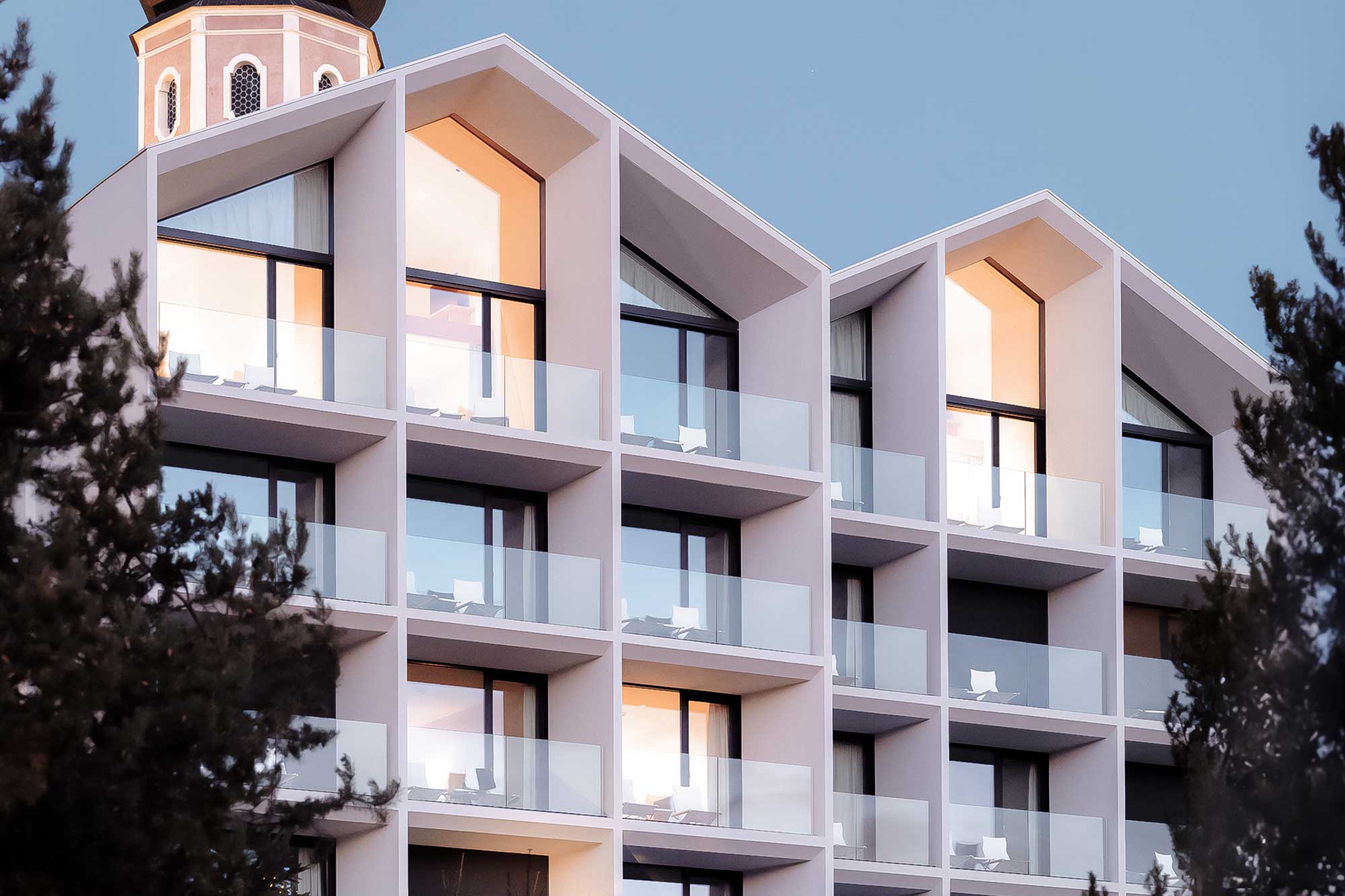
Castelrotto, 1,060 m · The village hotel, distilled · €€€
Rebuilt by Peter Pichler as chalk-white gabled volumes with not one decorative gesture too many. Pale oak, loden, lime plaster — alpine minimalism without the chill, the family still running the desk.
View hotel →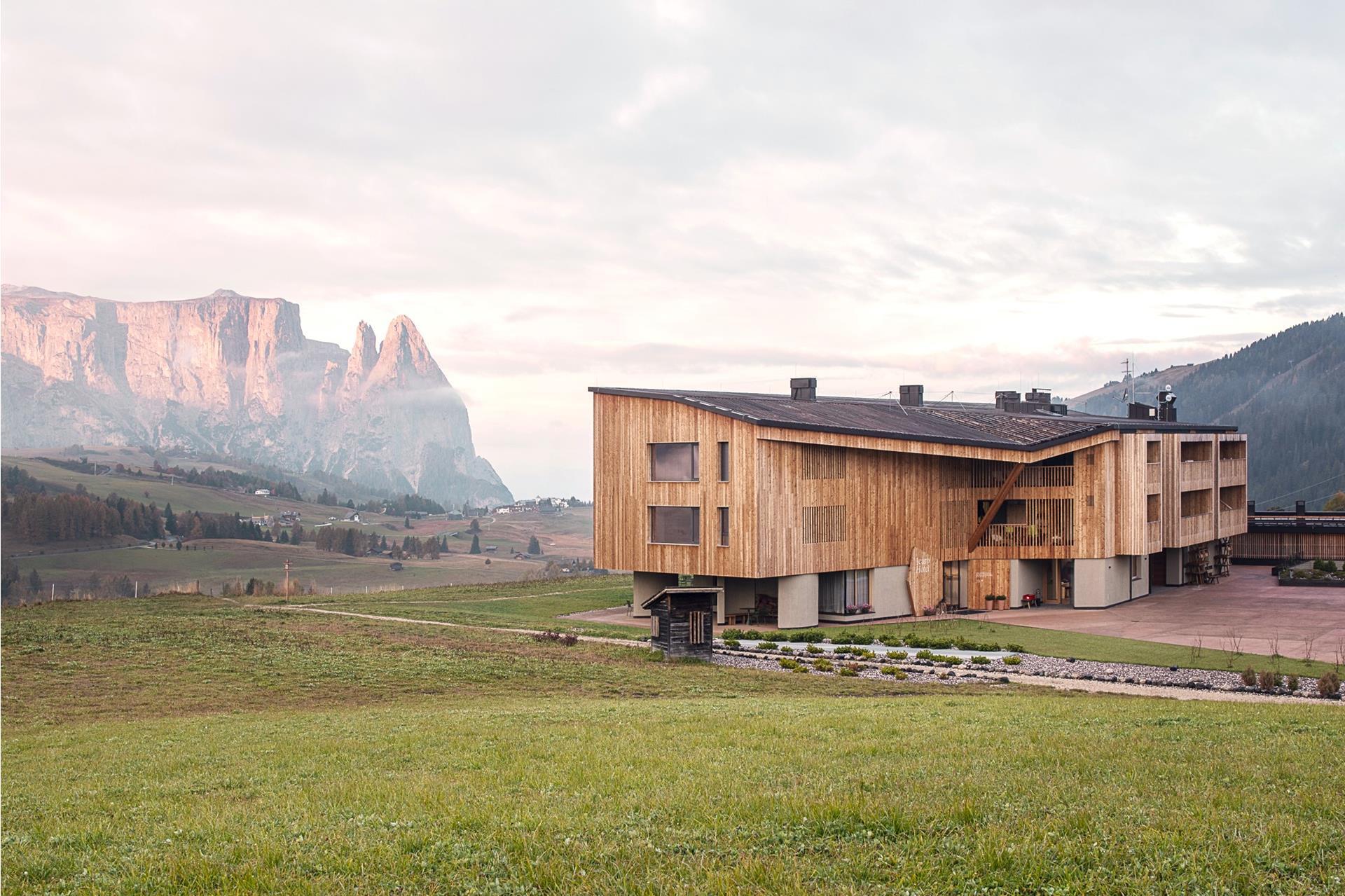

Alpe di Siusi, 1,910 m · The contemporary house on the meadow · €€€
MoDusArchitects wrapped a family house of the 1930s in a colonnade of thirteen branching timber columns and turned every room toward the rock. Twenty-nine rooms, an Alm spa, contemporary art through the house.
View hotel →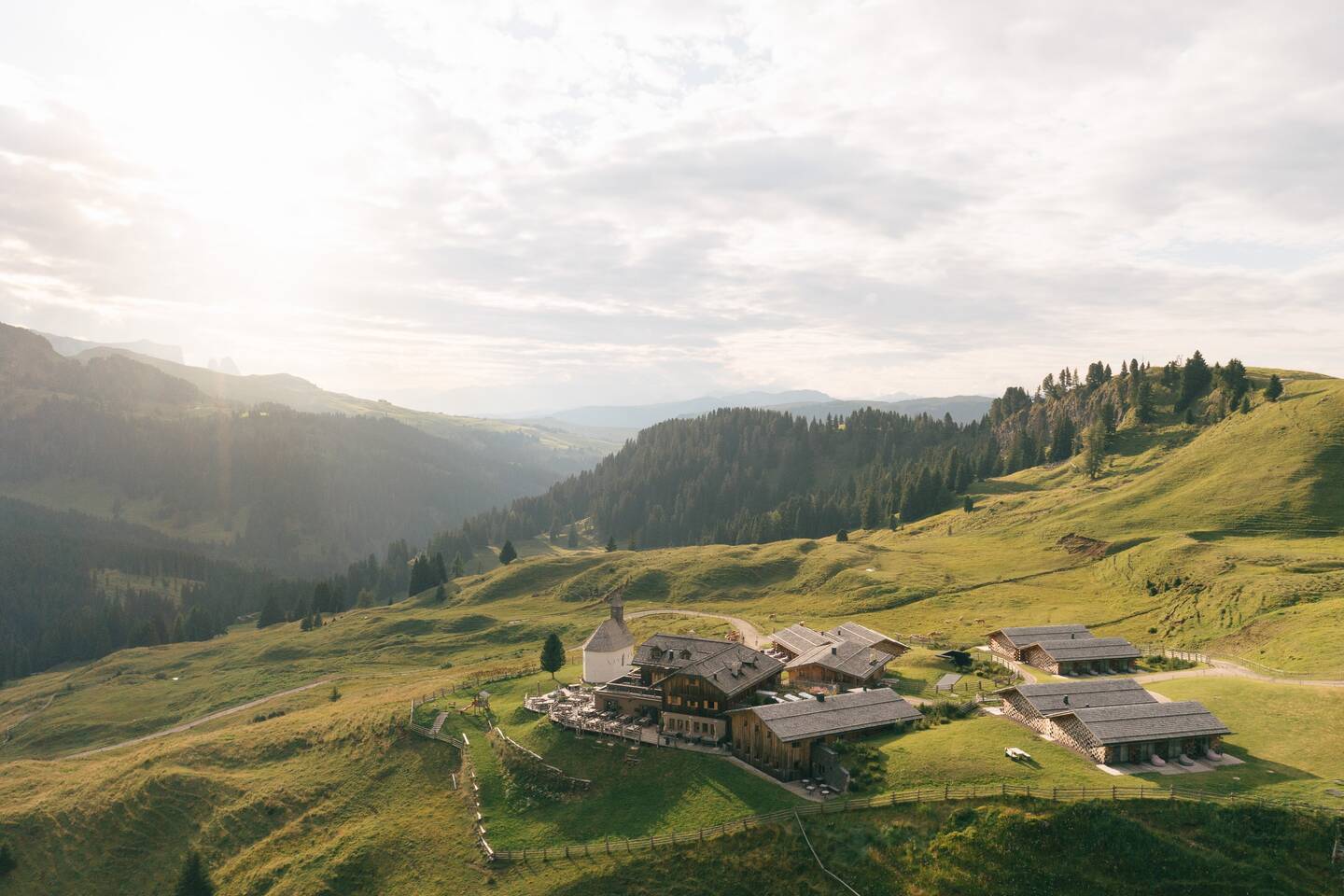
Alpe di Siusi, 2,054 m · The hamlet above the world · €€€
A nineteenth-century high dairy farm renewed by noa* as a small alpine village — historic house, larch-shingled sleeping barns, a sauna house alone in the grass. Arrival by cable car and shuttle; after five the silence is total.
View hotel →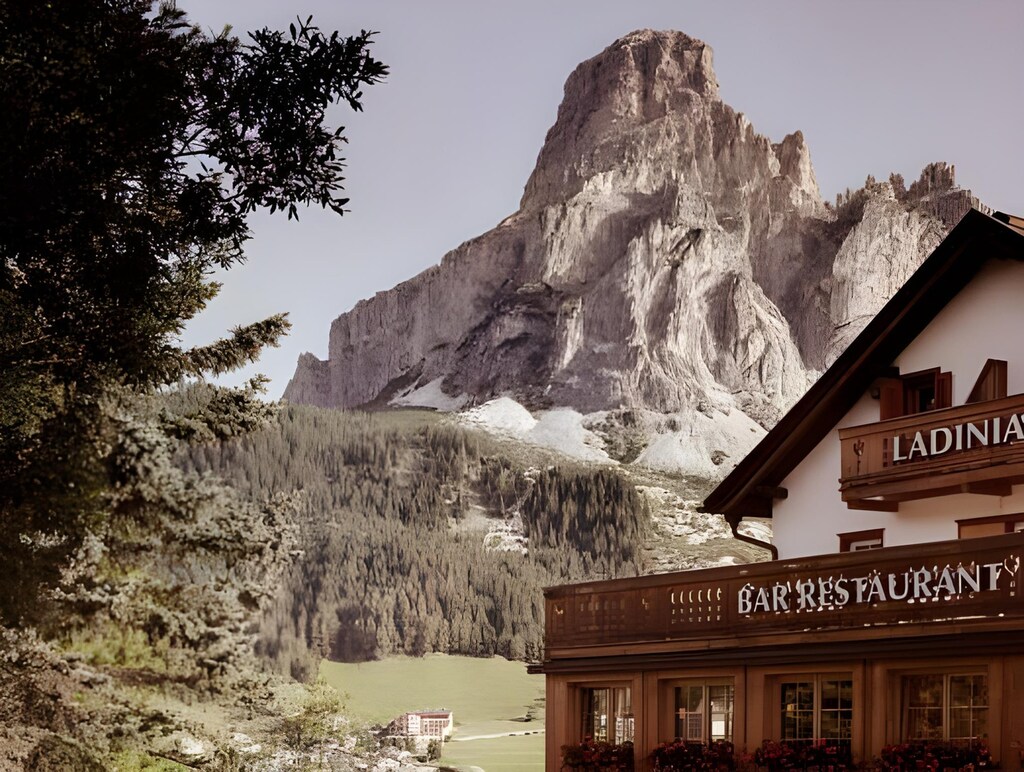
Corvara · The valley's first hotel, kept simple on purpose · €€
Corvara's first hotel, run by the same family as La Perla and deliberately left as it always was: thirteen tiny rooms under old timber, blue umbrellas facing the Sassongher, honest cooking in the stube.
View hotel →.jpg)
Corvara · The family argument for what a hotel is · €€€€
Three generations of the Costa family, rooms wrapped in old carved timber, corridors smelling of stone pine — and a common-good balance sheet auditing profit alongside its effects on the valley. Below it all, the Mahatma cellar: thirty thousand bottles in the dark.
View hotel →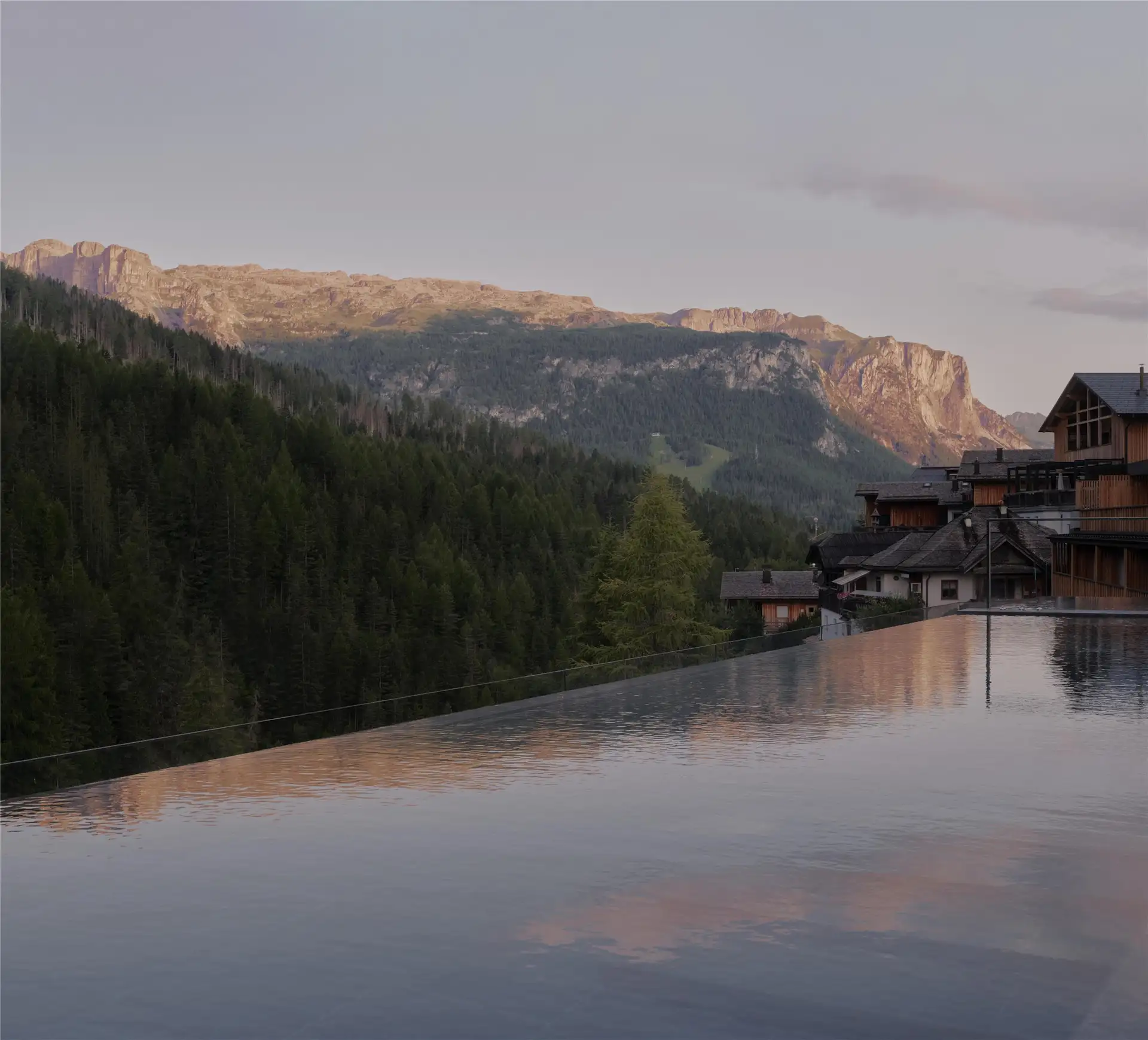
San Cassiano · The village inn, raised to world standard · €€€€
A 1939 village inn remade by Jean-Michel Gathy into a full Aman, with the founding family still in the building. Local timber, blackened metal, Dolomite stone, and fifty-one rooms where light is the principal decoration.
View hotel →The Seven Nights · Castelrotto
I.
Come up from Bolzano in the late afternoon, when the light is low in the Eisack valley and the road climbs through vineyards into forest and out onto the open plateau of Castelrotto, and the Sciliar is suddenly enormous on your right. This is not a resort but a farming town that happens to be beautiful: the bell tower, the painted façades, the fountain, the farmers' notice board in three languages.
The context worth having: in the forest below the Sciliar stands the ruin of Hauenstein, home of Oswald von Wolkenstein (c. 1377–1445) — knight, diplomat, brawler, and the greatest German-language poet-composer of the late Middle Ages. He travelled from Portugal to the Black Sea, lost an eye, was twice imprisoned by a lover's husband, and set it all to music. Every June the plateau remembers him with a medieval riding tournament.
The Dolomites are usually sold as timeless nature. This plateau has seven hundred years of well-documented, very human history — and a first plate of Schlutzkrapfen at a village Gasthaus is a good way to start.
The Seven Nights · Val Gardena
II.
Take the first cable car from Ortisei and walk the crest early: meadow on one side, and on the other the ground drops away into the tilted slabs of the Fermeda towers. The ridge is also a geology lesson at the perfect angle — the Dolomites began as tropical reefs in a Triassic sea, and the pale rock is fossilised coral. Lunch, if you stay up, on the terrace of the Baita Sofie.
If the crowds are the problem rather than the early start, take the Col Raiser gondola from Santa Cristina instead: the same massif from the south, the Regensburger Hütte beneath the towers, a fraction of the traffic. Quieter still is Resciesa, the funicular plateau above Ortisei, which trades the ridge for larch meadows.
The afternoon is for the valley's other trade, woodcarving: the Museum Gherdëina for the carving tradition's full arc, then the ateliers of UNIKA, the cooperative that refused the machine-copy trade. Wood shavings underfoot, stone-pine scent, and the same craft you will see in the beds and tables all week.
The Seven Nights · Alpe di Siusi
III.
The Alpe di Siusi runs on the sanest rule in the Dolomites: the road up closes to private cars through the middle of the day. Visitors come by cable car, and only guests sleeping on the meadow may drive, in a narrow window. The result is fifty-six square kilometres of rolling high pasture, Europe's largest alpine meadow, where the loudest thing at noon is a bell.
Ride up from Siusi or Ortisei and walk east, to where the meadow stops. The Rosszähne stand over the Tierser Alpl hut at 2,440 metres: four to five hours out and back from Saltria, the climb gradual rather than steep. Shorter days: the Puflatsch loop past the witches' benches, with hay soup at Gostner Schwaige — or no walking at all, and a horse-drawn carriage from Compatsch across the meadow instead.
Late afternoon is the hour to be here. By six the day-trippers are gone; by seven the meadow holds a few dozen people across fifty-six square kilometres, and the Catinaccio turns pink in the last light — the Rosengarten of the legend: King Laurin cursed his rose garden to be invisible by day and by night, and forgot the twilight.
The Seven Nights · Sassolungo
IV.
The full day belongs to the mountain standing over the meadow. The Sassolungo — Langkofel, “long stone” — is the western Dolomites' great monolith, and its circuit is one of the range's classic walks: five to six hours around the entire group, never technical, endlessly varied. Boulder fields, larch shoulders, sudden views into Val Gardena and across to the Sella.
Do it whole if the legs agree, or do its finest half and let the Rauchhütte below the south walls — low-ceilinged, wood-smoked, generations old — serve the long lunch. The detour worth taking: from Passo Sella, the tiny standing-room cabins of the Forcella del Sassolungo lift, two passengers upright, swaying up into the notch between the towers.
Return for the meadow's last evening. If the sky is clear, stay outside after dinner — with no village light for miles, the Milky Way over the Sassolungo is the better ending.
The Seven Nights · Passo Gardena
V.
Leave the meadow with the morning shuttle and drive up the Val Gardena to the Passo Gardena — the Grödner Joch, the high saddle between the two Ladin worlds. Cyclists race these passes; drive them slowly instead, pulling over where the road bends and the Sella's north wall fills the windscreen. Check the pass before you drive it: the two valleys are trialling limits on private cars in summer.
Down into Alta Badia, and by midday to the Museum Ladin Ćiastel de Tor, in the old bishops' castle at San Martino in Badia. It holds the valley's own account of itself: the eight hundred years of the abbey, the geology of the walls outside, and above all the language — how thirty thousand people kept a Latin dialect alive in five valleys.
Late afternoon, ten minutes on, is the same story outdoors: the marked path above La Val, through the viles — paired farmhouses of blackened larch and whitewashed stone, granaries on staddle stones. For dinner, L'ostì at the foot of the Sassongher is Corvara's independent restaurant: a short tasting menu of the Ladin canon, closed Mondays.
The Seven Nights · Alta Badia
VI.
Up with the first lift from Badia to La Crusc, while the church is still quiet and the wall behind it in shadow. The pilgrimage church has stood at 2,045 metres since the fifteenth century, under the sheer face of Sas dla Crusc.
Then the descent: two unhurried hours down through the Armentara meadows — the smell of cut hay, arnica, gentian, weathered grey barns, and more wildflowers than people the whole way. Reach the viles of La Val by early afternoon.
If the legs have had enough — this is the third walking day in four — trade the morning for the gentlest thing in the valley: the path from La Val up to the Ju de Rit, past a fifteenth-century chapel to a boggy tarn at 1,860 metres, three easy hours from the village door. Dinner either way at Maso Runch, a working farmhouse above Badia.
The Seven Nights · Fanes
VII.
Decide the last full day at breakfast, by the sky.
Clear sky — Fanes. The plateau is the setting of the Ladin national epic, the Kingdom of Fanes, reached from Capanna Alpina above San Cassiano. Forty minutes of steady climbing, then a broad high valley of karst and turquoise tarns. Walk as far as the Lé de Limo lake, listen for the marmots (in the epic, the kingdom's allies), and turn back hungry for Rifugio Scotoni — long tables under the Lagazuoi walls.
Cloud on the high walls — across the Falzarego instead. The Lagazuoi cable car rises to the open-air museum of the White War, where Italian and Austrian tunnels still thread the summit a century after both armies wintered at 2,700 metres. The farewell dinner is Corvara's — and, if it hasn't happened yet, the Mahatma cellar below the village, thirty thousand bottles; ask the hotel to arrange it.
The Seven Nights · Departure
VIII.
Departure · The Passes
For early risers: leave at five and drive the Sellaronda before anyone else is on it — the light reaches the rock in bands, and the only traffic is deer.
For everyone else: a last coffee in the village square — giulan, the Ladin thank-you — and down the valley. Bolzano, and Ötzi in the archaeology museum, are ninety minutes down the road, worth a stop on the way out.
Every excursion carries a crowd rating: how busy the place gets, weighed against how well it absorbs people. A single viewpoint fills up; fifty-six square kilometres of meadow do not. Where somewhere is crowded at every reasonable hour and an equal exists nearby, we send you to the equal.
Lifts run roughly mid-June to late September, into early October on some. The Armentara flowers peak from late June to mid-July. Late September brings the golden larches, the clearest walls and the emptiest ridge on Seceda — the best fortnight of the year if the dates are yours to choose.
The rose fire the walls take at dusk. This journey holds two of the best places in the Dolomites to watch it: the Catinaccio from the Alm meadow, and the Fanes walls from the Badia shelf. Both are at their best in the half hour after the last lift has gone down.
This is the walking journey of the four. Days Three, Four and Six each run four to six hours on foot, and every one has a shorter alternative written into it — the Ju de Rit is the gentlest, three easy hours from the village door. If a week of huts is not the holiday, Journeys I, III and IV run gentler.
Private cars may not drive up through the middle of the day in summer, roughly nine to five. Guests sleeping on the meadow are the exception — but arrive after the morning cut-off and you wait until it reopens, so come early. Day visitors book a parking slot in advance, or take the cable car from Siusi or Ortisei.
The Passo Gardena is being renegotiated in public. A capped-access trial for autumn 2026 was softened to a digital one — traffic counted, no barriers, no fines — with the data feeding whatever comes next. A five-month seasonal restriction is on the table for 2027; overnight guests have been the intended exception throughout.
Bun dé — good day; giulan — thank you. Two words of Ladin will carry you further in these valleys than your Italian. Ortisei, St. Ulrich and Urtijëi are one town with three names, and the third is the oldest. Everything here has three names, including the lifts.
Book the Seceda lift with the trip: it is the most expensive fare of the week and sells timed slots that go early in August. Much of the ridge is working pasture, so stay on the marked paths — some cross private land and carry a small fee. Pack a headlamp for the meadow's evening paths, and know the parking code: white free, blue paid.
Bolzano is forty-five minutes below Castelrotto; Verona, Innsbruck and Venice airports all sit around two hours out. The journey needs the car only at its ends and on the Day Five pass — everything else runs on lifts, shuttles and legs, which is rarer in these mountains than it sounds.
Sellaronda Bike Day in June and the Maratona dles Dolomites in early July close the passes to cars — glorious to watch, complicated to drive, so check the dates against the Day Five transfer. The UNIKA sculpture fair in September and the Wolkenstein Ritt in June are each a reason to come or a crowd to plan around.